Q1. How did you become an intuitive artist?
It came about through coincidences. I have no art school training, so when I first started getting this impulse to draw and paint, I turned to my imagination. I put pastels down on paper until they looked like something recognizable. Doing art this way was fun and took a lot of the pressure I was feeling as a journalist to think in a linear rational way.
Q2. So intuitive art means that there’s no planning or prior knowing what you’re going to draw?
Well, not exactly. The drive to do art I think is universally motivated by a desire to express feelings ideas and desires. You want to see these manifested in a tangible form.
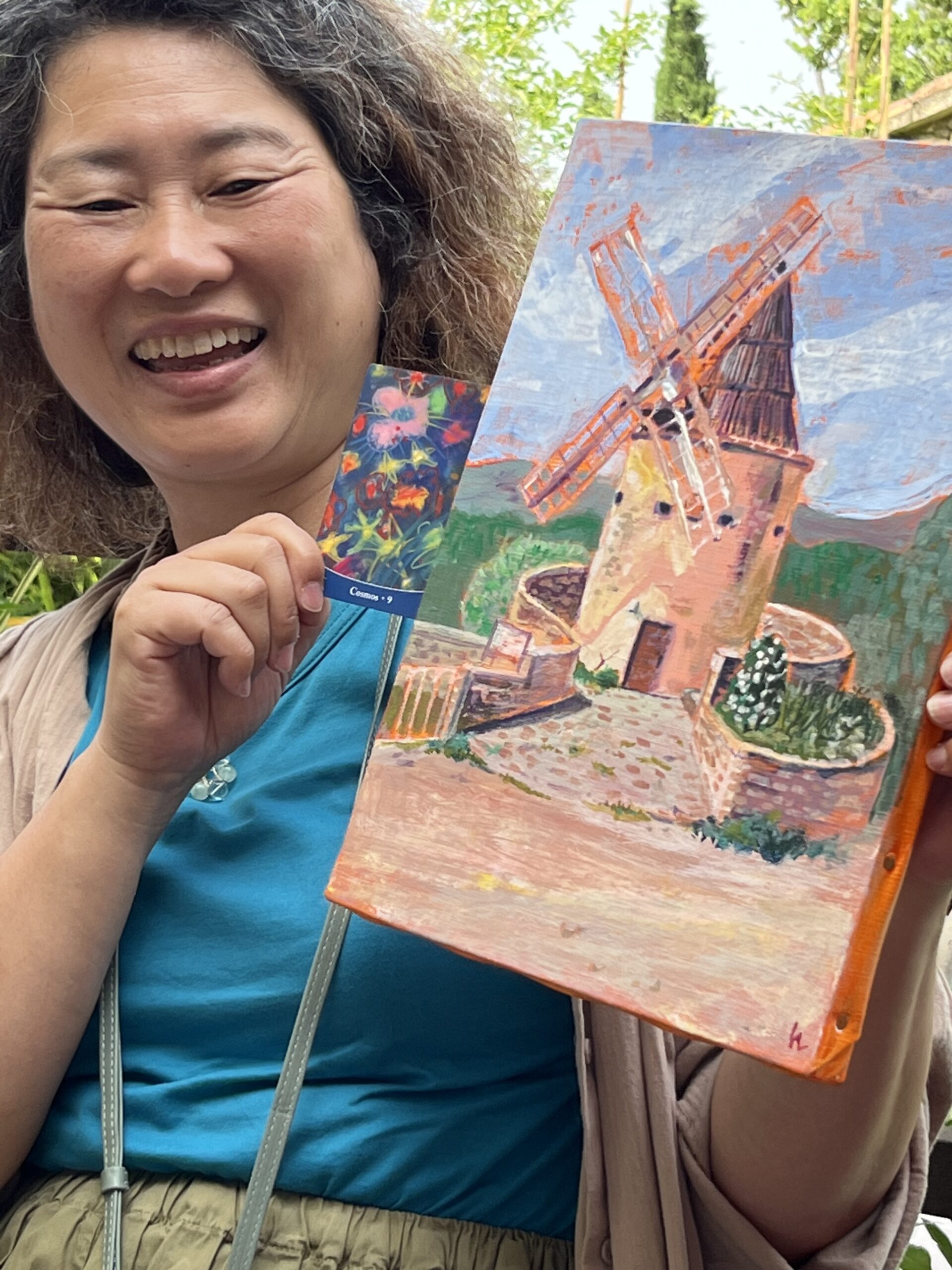
That’s what art’s about. So in my art, something that day in my environment or circumstances would set the mood. Like the first painting I ever did in my adult years, on my 36th birthday, came about at a wonderful home near Mount Fujii, where the artist Pam Honda was giving me and my husband Aki our first art lesson.
She put out pots of paint and paper and left us to it. No instructions! But it was a brilliant approach because it got us to relax and have fun and let go of expectations that art had to be a certain way
Q3. Is there an artist who inspires you to do intuitive art?
Yes, I can tell you about the intuitive artist who changed by life by making a very persuasive argument in favor of taking one’s own creativity seriously. Playful and serious at the same time.
This was Sachiko Adachi. She had been a colorist for a design firm in Tokyo until her late 30s, when she left because of growing demand for her art. She was like an advice lady and artist combined. People would come to her with a problem and she would draw them the solution! The pictures were very simple, more like calligraphy, with beautiful strong colors. In 1998 I was asked by Sachiko’s brother to edit Sachiko’s translated book, one of her last lectures. The book is called “To Live As We Are,” and I highly recommend it for everyone who is interested in the connection between spiritual development, creativity and intuition. Sachiko made an amazing case for doing art, saying the more you do, the more intuitive you become. This book influenced me in such subtle ways. I didn’t want to draw in Sachiko’s style but I took with me what resonated of her artistic philosophy–that the universe is always available to answer our questions and prayers through art.
Q4. Where can one obtain a copy of Sachiko’s book?
http://www.amazon.com/Sachiko-Adachi/e/B002DESEDG
Q5. Can you tell us about how the Genesis deck of cards came to be?
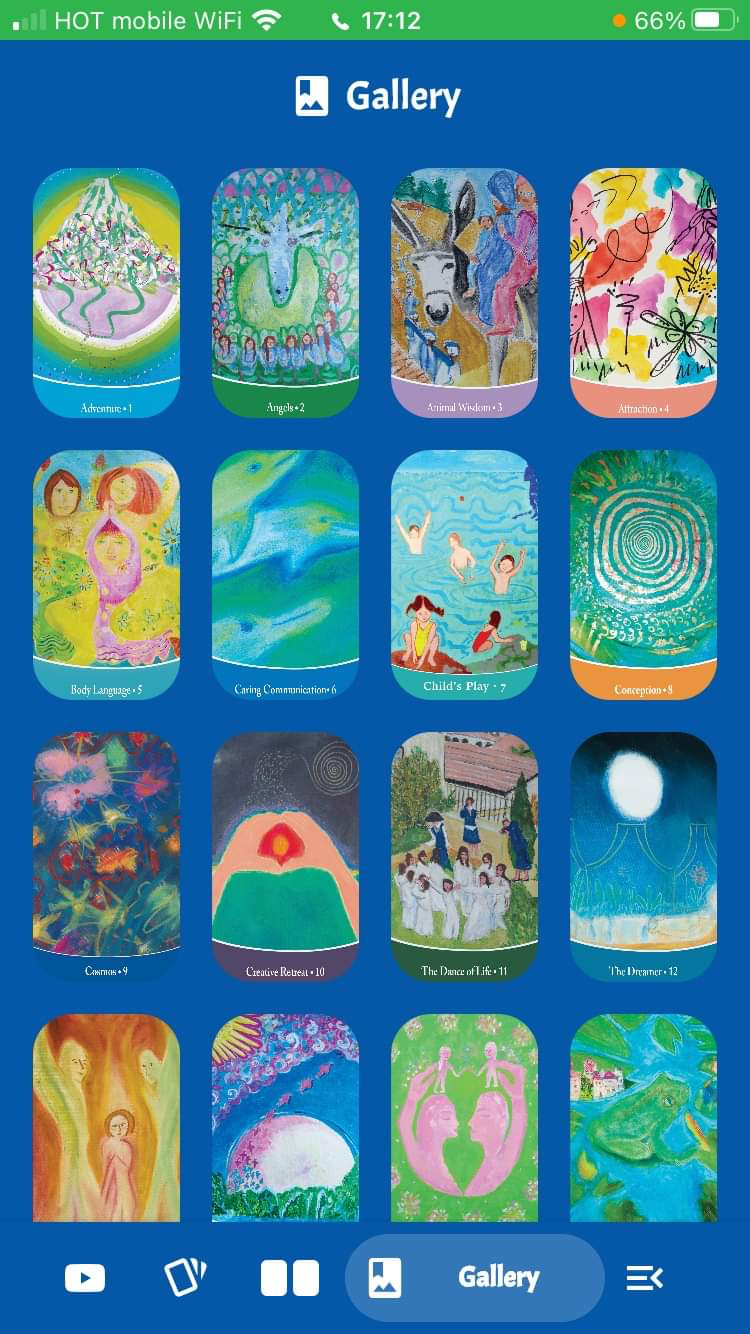
The Genesis deck began with paintings by me and the very talented artist Andy Boerger. When we first decided to collaborate in 2000, we would make these individual cards out of our works from our separate portfolios. As a writer, I would come up with the card labels, then together we would think up creativity exercises that people could do to break out of old patterns of thinking. I wanted to reach people who were pretty good at one creative form, art or writing, but had a hard time switching on the possibility that they could be good at both. Over time we discovered that the cards were effective as a tool to get beginners going as well.
Back in January ‘00, we started to give workshops in cafe settings, where we’d hang what at that time was a home-made laminated deck from a clothesline and our group would pick cards to help focus their intentions.
The Genesis Way tells everyone that it’s possible to do art, but I noticed that as long as the art was made mostly by Andy, an award-winning illustrator, the Genesis Way wasn’t fully walking its talk. My art is simple and childlike and I hope gives anyone the impression that they too can make art. So I made the difficult and scary decision of going it alone and making the “untutored” art myself in the summer of ‘2005. It felt like a miracle when September rolled around and the new paintings were done.
Q6. What’s the hardest thing that prevents people from doing art?
Definitely, it’s coming up with an idea. The Genesis Way gives you a place to start and a goal to reach for. But what you draw is entirely original. Say you pick the “Spring Seeds” card. That card will lead to all kinds of associations to explore about seeds you wish to plant for your own life. The cards always guide you to think positive about the potential of your life and by visualizing what you want in a work of art you are much closer to manifesting it.
Q7. What are the advantages of doing the Genesis Way in groups?
Our groups tend to be small. When a group do a Genesis Way creativity session for a few hours, everyone works at their own pace until the end. Then we talk and share what just happened. We all have this common bond through the Genesis Way, and when it comes time to talk about our experiences, it is amazing to see how a single Genesis Card leads the imagination to think and take action in new directions.
When you begin to talk about your own art and other people ask you questions, it opens up channels of thinking that weren’t there before.
Q8. Is the workshop setting the only way to work with the Genesis Way?
Actually, it’s only the beginning. I use them for private readings to look at personal issues.
It’s interesting how people are now finding their own uses for the Genesis Way. A French literature professor, uses the Genesis Cards to stimulate thinking in a university course she teaches here in Tokyo. My husband Akihiko Wakabayashi uses the Genesis Way in his “Consciousness” healing course. I’ve given the Genesis Cards to friends in the hospital and as gifts to people in need of cheer.
Q.9 How does the Genesis Way make you more intuitive?
The cards don’t make you intuitive. It’s the action you take as a result of the art that make that confirms how well your intuition is working. I’ll give a really simple example. Say you sit down and draw yourself on a tropical island even though you think there’s no way you can leave your job and family right now to take this sort of trip. Well, in your picture, you draw not only the beach but what’s that off in the corner? It’s a pod of dolphins.
A few days after the Genesis Way session, you get this sudden idea. Hey, I’m going to take the kids to an aquarium. Of course, there by the dolphin pool you run into an old acquaintance who reminds you of past times when you didn’t feel “stuck” at all. It’s a conversation that last minutes but changes your life because you are energized to try something new in your life. Well, that’s an example of the intuitive chain reaction that can come when you start to draw from the imagination and then take action on the things that come out of your pictures. I’ve experienced this so many times I just take it as the norm now.
Q. 10 How do we get started on the Genesis Way?
The Genesis Way deck of 44 cards with Guidebook can be purchased through my atelier for ¥3,000 (for overseas orders $40 includes airmail shipping). For Tokyo residents I offer a range of workshops and private consultations by appointment. A trial lesson to introduce the Genesis Cards costs ¥3,000 for 90 minutes, a private consultation to discuss a personal issue in your life that would benefit from a creative approach ¥11,000 for 90 minutes. Ongoing workshops on a private or semiprivate basis focus on developing intuitive artistic confidence, outdoor drawing in nature, cafe sketching, and learning to use the Genesis Cards in layouts and readings. Fees are ¥5,000 for a 3 hour class. Please feel free to contact me directly to make an appointment to take a class or to purchase the cards: 81-3-5477-5317 or liane@genesishealingarts.com.
Comments
Leave a comment Trackback